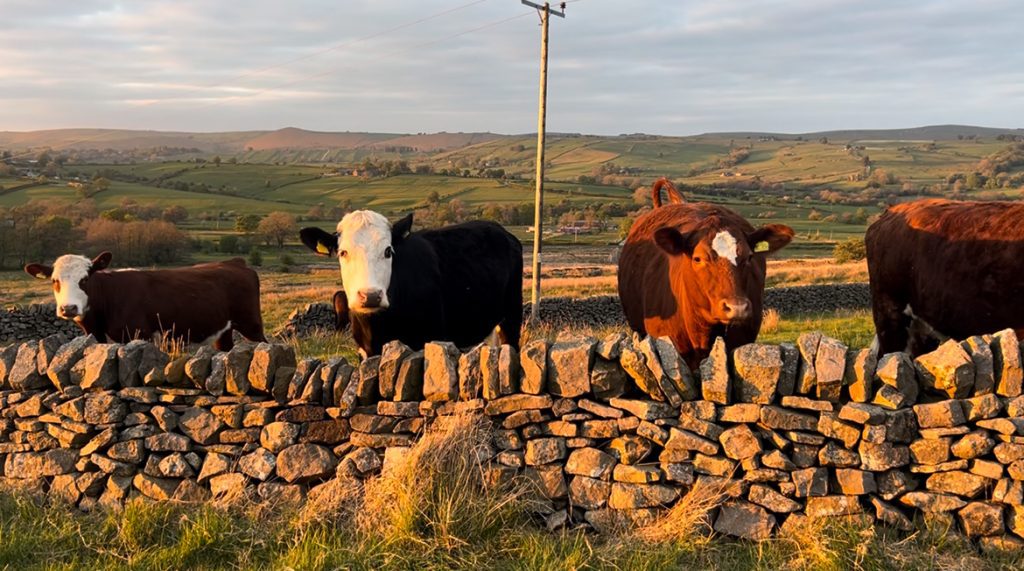
Here at Bernard’s Farm we use conservation grazing to care and steward traditional hay meadows and species-rich grasslands on and around our upland tenant farm in the Staffordshire Moorlands, to serve our local community with nutrient-dense food, combined with preserving habitats for nature.

What is conservation grazing?

Conservation grazing is a sensitive land management practice that integrates native-breed herbivores (cattle, sheep, ponies or goats) to maintain and restore biodiversity in natural and semi-natural ecosystems. Unlike intensive livestock farming, conservation grazing is designed to mimic natural grazing patterns and is carefully managed to achieve specific ecological outcomes.

Why conservation grazing?

The farm we tenant from the Peak District National Park Authority (PDNPA) is a traditional, upland hill farm with most of the land not being productive enough for more commercial agricultural enterprises, therefore better suited to lower impact management systems where food production and caring for wildlife can be combined. We steward a number of hay meadows, which are part of the remaining 3% traditional hay meadows nationwide. Many of the country’s hay meadows had to be drained and ploughed up for intensive food production following the second world war and were lost forever. The remaining hay meadows are therefore very special and require dedicated preservation. They are also home to ground nesting birds, such as rare curlew and skylarks and many native wildflowers such as . The farm’s hay meadows are shut up from April to July/August to provide habitat to ground nesting birds such as the rare curlew and lapwings, as well as allow wildflowers such as orchids, yellow rattle, ragged-robin, cuckooflowers and marsh marigold to flower and spread their seeds. Around mid July onwards, we start to watch for a weather window to harvest our annual hay crop which will provide nutritious food for our cows and sheep over winter when the grass stops growing. We run a herd and flock of native, hardy breeds; Hereford/Shorthorn/Angus cattle and Derbyshire Gritstone sheep and these breeds suit grass-based systems very well and do not require supplementary feeds which can cause poaching to the already wet, boggy upland pasture and meadows if we had to use equipment outdoors to feed them with. Whilst stewarding the land in a lower-input, sensitive manner we can combine nature and food production. We are just in the process of trying to procure some Bakewell Blue (Albion) cattle, too.

What are the goals of conservation grazing?

There are a few advantages of grazing for conservation; here are our ambitions:

  • To control invasive species in a low-impact, cost-effective manner. Grazing can suppress aggressive, non-native plants that might otherwise outcompete native flora. This also provides a varied diet for our cattle and sheep, as well as saves on the reliance of blanket chemical weed killers.
  • To maintain open grassland and wetlands that would otherwise become overgrown without grazing herbivores, leading to the loss of habitat for some species of birds, invertebrates and small wildlife.
  • To encourage plant diversity. We use our cattle and sheep to extensively graze larger parcels of species-rich grassland in this upland area, as well as allow them to ‘aftermath graze’ the farm’s hay meadows following a late hay cut in July/August.
  • To enhance ecosystem resilience. Adhering to lower stocking rates of cattle and sheep allows us to create a varied sward height across the pasture and meadows, creating a biodiverse mosaic of habitat for wildlife. due to their bulk and grazing technique, cattle are the perfect cropping, fertilising vehicle for creating a diverse and varied sward structure. Their ‘pats’ are homes and food for insects and beetles, which in turn are food for birds and small mammals and eventually, our cattle and sheep will provide nutrient-dense, nature-friendly farmed meat boxes for us to eat, too.
  • To preserve rare and native breeds of cattle and sheep which are at risk of being lost. We keep Derbyshire Gritstone sheep and plans to procure Bakewell Blue Albion cattle which are listed as at risk rare breeds on the Rare Breeds Survival Trust watchlists. Both of these breeds originate from nearby Buxton and we think they are part of the area’s cultural heritage, and importantly, they suit this type of grassland very well and do well on it, without the need for supplementary feeding. We think it would be a shame to loose them from the landscape.

What are the challenges of conservation grazing?

Conservation grazing isn’t a solution for every farm and land management system, and requires close observation and commitment to maintain. Here are some of the challenges we have found:

  • Careful timing and stocking rates are required. The best-laid plans can all be ruined by extreme weather (draught/flooding) and dictate stocking rates to be adjusted to prevent over or under grazing land.
  • Long-term monitoring is needed to measure impact.
  • Financial backing is required in order to manage land for conservation and nature. This is especially helpful for tenant farmers such as ourselves; we adhere to lower stocking rates of sheep and cattle and this is helpfully reflected in our ground rent by our landlord. Farmers/land managers are also required to access agri-environmental schemes which also help farmers to manage for nature and wildlife, as well as food production. We have found the Sustainable Farming Incentive (SFI) beneficial; however prior to securing our tenant farm last Autumn 2024, we were not eligible for any government schemes and grants and additional, off-farm income was crucial to us in order to provide for our family, as well as establish a farm business from scratch as first-generation farmers.

Written by