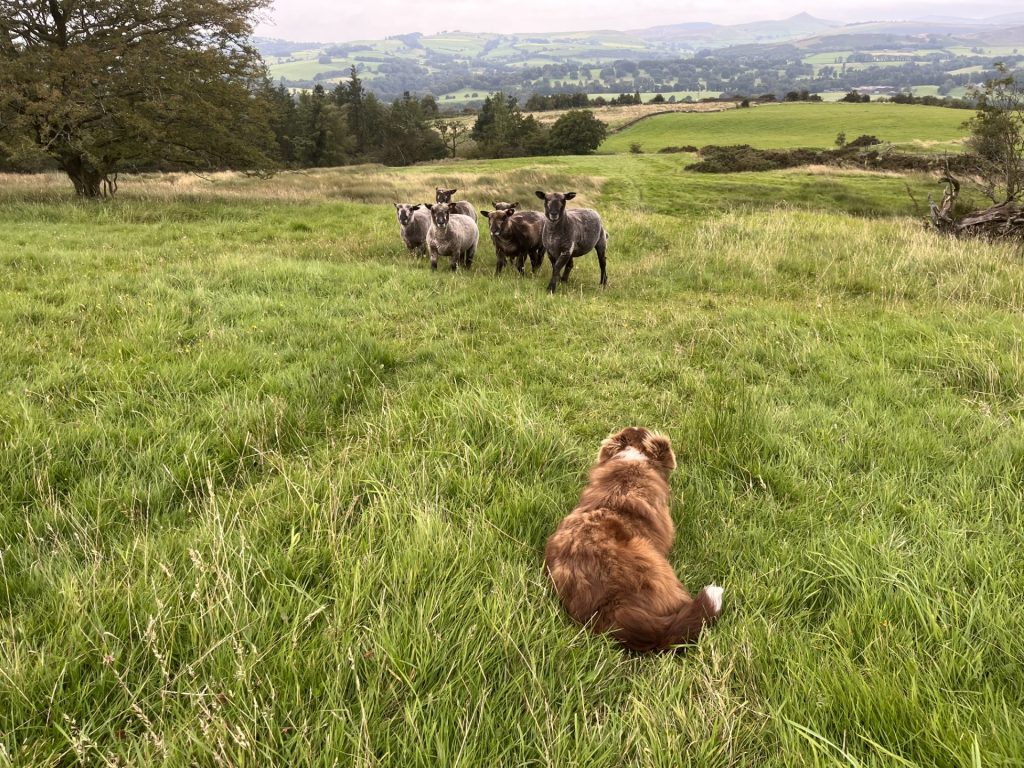
Here at Bernard’s Farm we run a closed, pedigree flock of Coloured Ryeland and Ryeland sheep; Bernard’s Farm Coloured Ryelands (black) and Barbara’s Farm Ryelands (white). We started out by rearing wethers (castrated male lambs) for meat boxes, and then purchased our two original Coloured Ryeland ewes in 2019 and grew from there. Ryelands are one of England’s oldest sheep breeds, going back seven centuries when they were used by monks in Herefordshire to graze the rye pastures, giving them their name.

The Rare Breed Survival Trust lists them as a minority breed, having previously been classed as rare. They are no longer a commercial breed, as the lambs are not fast-growing or can produce the weights preferred by large commercial sheep farms. The paperwork is doubled because of the rare breed flock society regulations. However, being involved in preserving a protected sheep breed is very exciting and ethically conscious.

Ryeland sheep are lowland sheep (not suited to the extreme temperatures of the hills) and are dual-purpose. They provide exquisite fleeces that will be spun into wool and used to produce handmade children’s blankets and cardigans. They also produce slow-grown quality meat boxes twice yearly: spring and autumn.

Our Values

Based in the Staffordshire Moorlands as upland tenant farmers, we farm with two priorities;

  • High animal welfare featuring low-stress handling methods and traditional, natural sheep care as much as possible. We lamb outside in April to combine the spring grass growth with lactating ewes and growing lambs, and do not routinely worm our sheep, instead keep a flock health plan featuring vaccination, preventative care and regular FEC (fecal egg count) sampling.
  • A nature-friendly approach: the use of herbivores in managing grasslands. Older ewes are used for conservation grazing of species-rich pasture. The farm is an ecosystem, supporting habitat for nature, wildlife, birds, and invertebrates, as well as environmentally conscious food production.

First Generation

Starting out as first-generation farmers has been a challenge; we rely on rented ground as we are tenant farmers and do not currently have a lambing shed. We lamb outdoors in April, which seems to get harder and harder every year due to the inclement weather. Ryelands are hardy, native sheep and generally are maternal ewes, rearing their lambs with care and dedication. The lambs are born with a good covering of fleece and can stand rain and cooler temperatures, but excessive rain, wind and snow in April seems to be getting worse. Without any shelter, it is a stressful time. We are out in all weathers with the sheep, trying to make what shelter we can out of sheets of metal and tarpaulin, and we are hoping to have found a lambing shed for our flock for Lambing 2025, and with it the opportunity to expand the flock to around 80 – 100 ewes. 

Traditional Methods

Traditional, low-input approach to farming with one crop of field-dried hay per year from hay meadows. Being first-generation farmers has been challenging in many ways, emotionally, financially, and practically; however, it has afforded us the luxury of being able to research and choose the way that we wish to farm.

We don’t routinely worm our flock, as the chemicals in wormers harm and kill invertebrates and wildlife in the soils. Instead, we submit 8-week FEC (faecal egg count) samples to our vet, who looks at the sheep’s dung under a microscope and decides if and which worm the sheep may have. This means that we can target the correct anthelmintic (wormer) rather than routinely administering it.

Nature has a solution—and it is cows—that alternates the grazing of sheep and cattle. This massively helps to keep on top of worm burdens, as each is a dead-end host of the other’s worms. The other tactic we use is lower stocking levels and rotational grazing, which help to reduce gastrointestinal worms.


Summer shows and sold in autumn as pedigree breeding stock

Beginning to End

We take responsibility for our lambs from beginning to end, from the moment the are conceived in the autumn in our ewes to birth in spring and to their end which is another 12-18 months later. Our lambs are slow-grown, grazing species-rich grasslands and meadows, and we believe this is an ethical , economic and practical decision as it also means that the meat that is produced is incredibly tasty.

Our Loyal Customers Tell Us

Our local and loyal customer base tells us the meat tastes like meat used to. We believe there are two explanations for this;

Our lambs are raised with high welfare standards and low-stress handling methods. We also take them to the abattoir by ourselves when it is time, which again means low stress. This also contributes environmentally to low food miles and a reduced carbon footprint.

The other reason we believe our meat will beat mass-imported, lower-welfare supermarket meat from commercial breed lambs that are culled at four months of age is that the meat you receive from us is as fresh as it can be. We have only collected it ourselves hours before you do from our trusted butcher. When you purchase a meat box from Bernard’s Farm, you can rest assured that you are consuming high-quality meat from animals that have received high welfare standards from beginning to end.

The soils feed the grass, which feeds the animals and plants, which feed us. Until humans have the complex digestive system to extract the minerals and goodness from grass, we shall consume meat. On the condition that the animals lived a full, healthy life, with the freedom to behave and live as an animal should. We take our animals to the end destination ourselves, and only to abattoirs that provide smallholder services. All of our animals are treated with respect, care, and dignity that they deserve.

We are incredibly grateful to our loyal customer base in and around Leek, Macclesfield and Biddulph, and are also pleased to share that we have supplied our local pub, The Ship Inn at Wincle with Lamb recently, and hope to be able to supply more again in the future.

Support local business and family.

When you buy meat directly from the farmer, especially a smaller, tenanted family farm such as ours, you are keeping us afloat financially, too. Being able to predict what it will cost to produce, and what is left for our business, helps to protect against market volatility and

Don’t forget the wool

The other fabulous thing about sheep is, of course, their wool! Our flock is sheared in June. Pa used to be our shearer when we started out, but now, with 50 ewes and their followers, we have a brilliant shearer who completes the task in minutes.

Ryelands are notoriously one of the most challenging sheep to shear because they are so densely covered in wool, and it is everywhere: their limbs and faces, too.

We proudly send our wool to British Wool and have also had some fleeces processed into wool for our sheep’s wool goods that are for sale on our website, or you can support us at the Leek Show in July and Macclesfield Sheepdog Trials in August. Sadly, since the closure of a local mill, it has not been financially viable to have our own fleeces carded, spun and processed, and we are trying to find a closer, affordable alternative or to build up a network of crafters who would like to purchase the fleeces off us at a more economical price.

100 years ago, the wool sale would have paid the tenant farmers’ rent. This is unimaginable for us, as the sale of the wool no longer even pays for the cost of the shearer – never mind a month’s rent! Sheep are shorn for their own welfare these days, a sheep not shorn and left with a full fleece on their backs would most likely fall victim to blow fly and their maggots who lay their eggs in the fleece, which feeds off the sheep’s skin and blood.